
Affidea Praha
Description
Affidea Praha s.r.o. - Chodov is a private medical center that has a contract with most czech insurance companies, provides highly specialized diagnostics and medical care in the fields of cardiology, internal medicine, angiology, endocrinology, rheumatology, osteology, neurology, nephrology.
As part of radiology, we offer magnetic resonance, CT - computed tomography, densitometry and ultrasound (sonography).
We also offer an occupational healthcare, preventive examinations, consultation for travel medicine, vaccinations, etc.
For more than 20 years, we have been conducting clinical trials within our Clinical Trial Center (CKH), both within our own specialties and by performing examinations (CT, MR, DXA) for other sites.
Our Services









Info
Monday - Friday 07:00–19:00
Bus
bus 177 to Petýrkova then walk 350 m
bus 115 to Chodov then walk 650 m
Metro
Line C to Chodov then walk 700 m
Parking
Parking options nearby
bus 177 to Petýrkova then walk 350 m
bus 115 to Chodov then walk 650 m
Metro
Line C to Chodov then walk 700 m
Parking
Parking options nearby
Doctors
Anesthetist
Angiologist
Cardiologist
Clinical osteologist
Endocrinologist
Internist
Neurologist
Obesitologist
Osteologist
Radiologist
FAQ
Obesitology - frequently asked questions
Is it necessary to have a recommendation from the attending physician for the obesitology clinic?
A referral from a general practitioner or other specialist is appropriate, but not a requirement.
Is it necessary to bring personal documentation or previous documentation from similar consultations to the examination at the obesitology clinic?
It is not necessary, but it is an advantage. This is comprehensive care, and a statement of personal documentation from a general practitioner or other specialists (consultants) is suitable for optimizing care.
Is the examination in the obesitology clinic covered by health insurance?
Yes. Examination in the obesitology clinic is covered by health insurance.
Is nutritional consulting covered by health insurance?
The follow-up with nutrition consultant is paid by the client.
MRI
Are there any contraindications when the examination cannot be performed?
Our department cannot perform examinations on patients with pacemakers (even MR "compatible" ones).
It is very important to inform the radiology assistant about all devices you have in your body (insulin or infusion pumps, electrodes, pacemakers, clips from previous surgeries, prostheses, piercings, magnetic false eyelashes, hair extensions, etc.). In some cases, it is not possible to perform the examination at our clinic for these reasons.
It is very important to inform the radiology assistant about all devices you have in your body (insulin or infusion pumps, electrodes, pacemakers, clips from previous surgeries, prostheses, piercings, magnetic false eyelashes, hair extensions, etc.). In some cases, it is not possible to perform the examination at our clinic for these reasons.
How does the MRI scan work? Are medications administered?
The patient lies down on the examination table and lies down according to the instructions of the staff. You must remain still during the image capture so that the image is not blurred. It is sometimes necessary to use contrast agents, which may be given to the patient intravenously, orally or in the cavity before or during the examination to increase diagnostic accuracy. You will be asked to sign an informed consent form. If the contrast agent is intravenous, an intravenous cannula will be inserted, most commonly into a superficial vein in the elbow area. In these cases, it is advisable to drink plenty of fluids in the hours after the MRI scan to help the contrast medium be excreted more quickly in the urine. Patients suffering from claustrophobia may need sedation before the examination. This preparation is carried out by the anaesthetist using a standardised procedure.
How to prepare for an MRI?
For examinations without sedation or other special preparation (liver, kidney, pancreas, enterography) it is not necessary to go on an empty stomach. For examinations where the patient's cooperation is required during the examination (liver, kidney, pancreas, enterography), analgosedation is not possible.
How is the examination carried out?
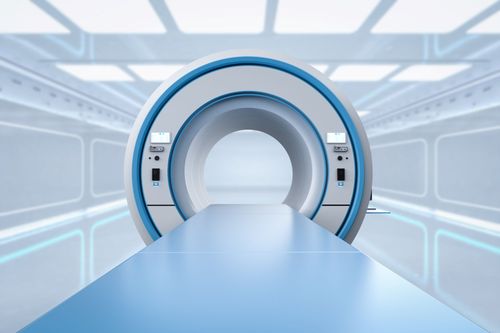
The radiology assistant will give you instructions on the procedure, disposable clothing will be provided if necessary, it is essential that you leave all metal objects such as jewellery, coins etc. in the cabin. If intravenous administration of a contrast agent or sedation is required, an intravenous cannula will be inserted, usually into a superficial vein in the elbow area. All patients requiring sedation are monitored throughout the examination with a pulse oximetry monitor. The patient enters the tunnel of the machine and the examination is started. The examination is accompanied by noise, which can be unpleasant. For this reason, we offer patients hearing protectors to minimize this discomfort. It is important that the patient is completely at ease so that good quality images can be obtained. The length of the examination varies depending on the type of examination you require. It will usually not exceed 45 minutes. If you need sedation, you will be monitored by an anaesthetist who will monitor your vital signs using equipment such as a heart rate monitor or oximeter.
Why do I wear earmuffs during the examination?
The production of radiofrequency pulses, which are used to obtain MR images, is accompanied by noise that can be unpleasant. For this reason, we offer patients hearing protectors that minimize this discomfort. In some cases, you will be asked to wear headphones into which you will receive instructions to hold your breath.
How much radiation will I be exposed to?
MRI does not use ionising radiation. It uses electromagnetic waves that do not damage the body.
Can I have an MRI if I am claustrophobic?
Claustrophobic patients should be specially prepared for this procedure, e.g. use anxiolytics. You will be given a signal balloon in your hand, which will trigger an alarm. If despite everything the feeling of claustrophobia persists, you squeeze the balloon in your hand and the procedure stops immediately. If all these measures fail, the procedure will be performed under analgosedation. We do not perform examinations under general anaesthesia at our clinic.